
In eukaryotes, DNA replication is initiated when two ring-shaped hexameric helicases load at defined DNA sites, called origins, and engage one another in a head-to-head arrangement. Acting as a double hexamer, they open the origin duplex and set up two divergent replication forks, exposing the single-stranded templates that replicative polymerases require. To define the structural events underlying this initiation step, we used cryo-electron microscopy (cryo-EM), taking the SV40 Large Tumour Antigen as a tractable AAA+ helicase that recapitulates central features of the eukaryotic replication machinery. We found that each helicase engages and melts its own half of the origin in a manner that is both independent and symmetric. Local melting spans a minimum of five base pairs across the early-palindrome and AT-rich elements of the origin and depends on the stepwise addition of LTag subunits, on ATP binding, and on a reorganisation of the helicase’s DNA-binding loops, which switch from a planar to a staircase-like spiral arrangement as they contact the DNA tracking strand. Together, these events drive strand separation inside the helicase channel and leave each hexamer poised for ATP-powered translocation. We propose a model in which the duplex is subsequently sheared and the two helicases decouple, yielding bidirectional replication forks. The high conservation of the hexameric helicase core points to a general mechanism that extends from SV40 virus to the replicative helicases of eukaryotes.
Structural Basis of Bidirectional Fork Initiation by SV40 LTag Helicase
Abstract
Speaker
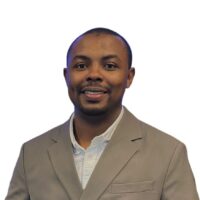
Ammar Danazumi
Biomedical Sciences Division, King Abdullah University of Science and Technology
About (click to open/close)
I am a postdoctoral fellow in the Biomedical Sciences Division at the King Abdullah University of Science and Technology (KAUST), where I use cryo-electron microscopy to study the helicase-primase complexes of human cytomegalovirus and Epstein-Barr virus. I completed my PhD in Bioscience at KAUST in 2025 under Prof. Alfredo De Biasio, with a thesis on the structural basis of bidirectional replication-fork initiation by the SV40 Large Tumour Antigen helicase. Before that, I earned an MSc in Biotechnology at the Warsaw University of Technology and the University of Warsaw in the laboratory of Prof Maria Górna, studying the interactions between the human FAST and eIF4E proteins, with an Erasmus exchange at the University of Groningen. My training began with a BSc in Biochemistry at Ahmadu Bello University, Zaria.
My research combines single-particle cryo-electron microscopy and molecular dynamics simulation to understand conformationally dynamic nucleoprotein assemblies, in particular, the machinery of DNA replication. My main scientific contribution to date concerns the structural dynamics of DNA unwinding by a replicative helicase, published in Nature in 2025, alongside studies of the human replisome and clamp-loading machinery that appeared in eLife and Nucleic Acids Research. I retain a strong interest in African parasitic diseases, dating from my work in Nigeria on multi-epitope vaccine design and on drug targeting in Trypanosomes and Plasmodium.
My research has been supported by competitive fellowships and awards, including the KAUST PhD Fellowship, a Polish-Fulbright BioLAB Studentship, an EMBL EIPOD INSPIRES mentorship, an Erasmus+ scholarship, and the Ignacy Lukasiewicz scholarship of the Polish National Agency for Academic Exchange. In 2025, I received the Best Research Award of the Division of Bioscience at KAUST for my work on DNA unwinding by a replicative helicase.
Selected publications (click to open/close)
RSVP to this event
About
The Biophysics in Africa Monthly Colloquium Series is a joint project of the African Light Source Foundation (AfLS), African Physical Society (AfPS), and the South African Institute of Physics (SAIP). SAIP is an adhering body of the International Union of Pure and Applied Biophysics (IUPAB). The colloquia are always on the last Wednesday of every month. In addition to participation by students and colleagues worldwide, we invite speakers from around the globe as well. For more information please feel free to contact us at colloquium.series@africanbiophysics.org